Being told that a drain needs excavating can make it sound as though digging is the obvious next step. Sometimes it is. A crushed pipe, a badly displaced joint, a failed connection or a section that has lost its line and level may need to be exposed and replaced.
However, excavation should follow a clear diagnosis. Before a path, driveway, garden or floor is opened, the customer should know what has failed, where it is, who owns the pipe and why the proposed access point makes sense.
That preparation matters because the pipe is only one part of the job. A well-planned drain excavation in Bournemouth should also account for buried services, working space, spoil, pipe bedding, nearby trees, access chambers and the surface that must be reinstated afterwards.
This guide explains the checks to make before approving the work. It does not replace a site-specific assessment, but it will help you ask better questions and recognise when a recommendation needs more evidence.
The short answer
Before authorising excavation, ask for confirmation of:
- the defect and the evidence showing it;
- the exact position, depth and length of the failed section;
- whether the pipe is private, shared or part of the public sewer network;
- why a non-excavation repair is unsuitable;
- the proposed excavation size and access route;
- the location of electricity, gas, water and communication services;
- how the replacement pipe will be bedded, connected and tested;
- what surfaces, planting or structures may be disturbed;
- exactly what reinstatement is included;
- the price, exclusions, contingency arrangements and guarantee.
If several of those points are missing, the job may not yet be ready for approval.
1. What evidence shows that excavation is needed?
A recurring blockage does not automatically prove that a pipe has collapsed. Grease, wipes, scale, roots, silt and other obstructions can all restrict flow without requiring the drain to be dug up.
The first question is therefore simple: what evidence shows a structural fault that cannot be resolved by clearing or an internal repair?
In most cases, that evidence comes from a properly completed CCTV drain survey in Bournemouth. Useful footage should show the affected pipe clearly enough to identify the fault and understand its extent. Depending on the problem, it might reveal:
- a pipe that has crushed or lost its shape;
- a severe joint displacement;
- a broken or missing section;
- a connection that has separated;
- a drain belly or loss of fall that requires the pipe to be re-laid;
- continuing soil or root entry through a structural opening;
- a chamber connection that has failed externally;
- a bore that is no longer stable enough to accept a liner or patch.
Ask to see the relevant footage or still images. A recommendation such as “the drain looks bad” is not enough. The engineer should be able to point to the defect, explain what the image shows and connect that finding to the proposed repair.
Was the pipe clear enough to inspect?
The camera view also needs to be usable. Standing water, heavy scale, roots or debris can conceal the pipe wall and make a fault look different from what it is. Where practical, the drain should be cleared or cleaned sufficiently before a final structural assessment is made.
That does not mean every inspection needs a perfectly clean pipe. It means the visible evidence should be good enough to justify disruptive work. If the camera could not pass the obstruction or the image remained unclear, the quotation should say so rather than presenting an uncertain diagnosis as a confirmed collapse.
Our guide to how a CCTV drain inspection reduces guesswork explains what an investigation can establish before repairs are selected.
2. Has the failed section been located accurately?
Finding damage on camera is only part of the investigation. The engineer also needs to translate the camera position into a reliable location above ground.
Before excavation, ask for:
- the measured distance from a known chamber or access point;
- the approximate depth of the drain;
- the direction of the pipe run;
- the pipe diameter and known material;
- the estimated length of pipe that needs exposing;
- a surface mark or simple sketch showing the target area;
- an explanation of how the position was confirmed.
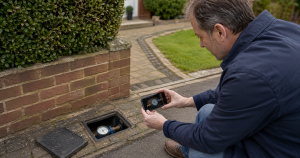
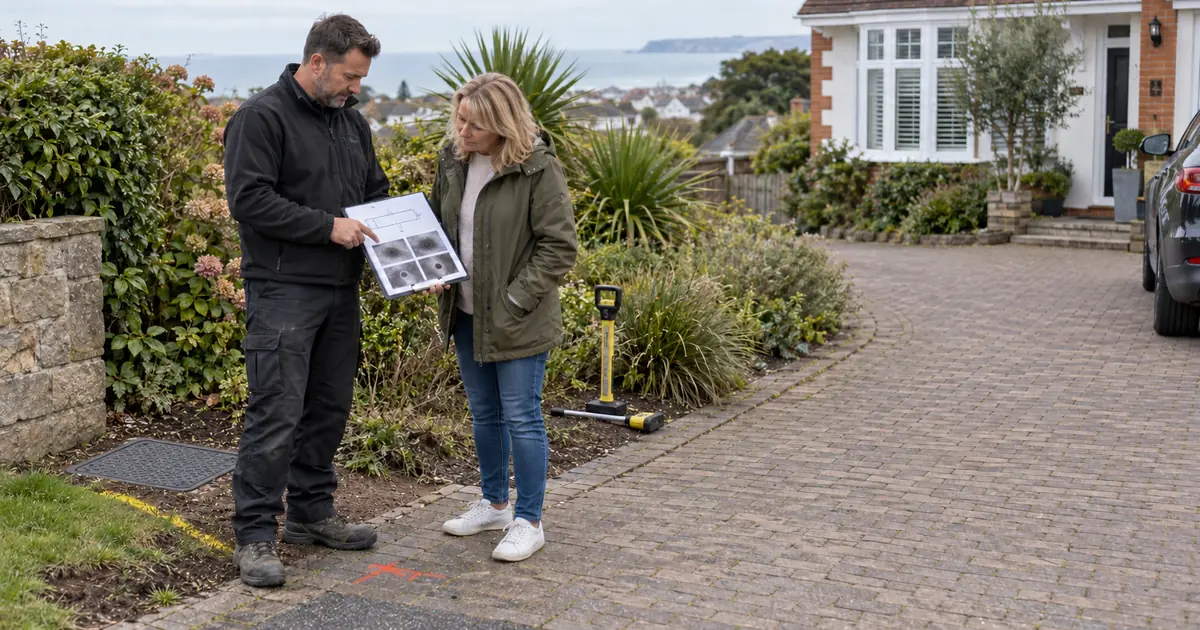
Camera distance counters are useful, but they should be interpreted carefully. The camera cable can bend through chambers and changes of direction. Where precision matters, engineers may use a sonde and locator to trace the camera head from the surface.
Accurate location can be the difference between a small targeted opening and unnecessary damage to a wider area. It is especially important when the drain passes beneath paving, a driveway, a garage floor or a restricted side passage.
3. Is the problem on a private drain or a public sewer?
Ownership should be checked before a customer pays for excavation.
Wessex Water’s sewer-pipe responsibility guidance explains that it maintains the public sewer network and that most shared sewer pipes are also its responsibility. A pipe serving only one property within its boundary will commonly remain the property owner’s responsibility, but the layout must be established rather than assumed.
Ask these questions:
- Does the affected drain serve only this property?
- Has it already joined drainage from another property?
- Is the fault inside or outside the property boundary?
- Is the pipe shown on the water company’s sewer records?
- Does a managing agent, freeholder or neighbouring owner need to be involved?
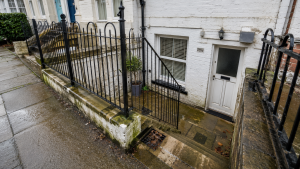
Shared drainage can be difficult to recognise in converted buildings, older terraces and properties where extensions have altered the visible layout. A chamber may sit in one garden while carrying flows from more than one address.
If ownership is uncertain, resolve it before approving private excavation. There is little value in paying to open the ground and then discovering that the affected section should first have been reported to the sewerage company.
4. Why has excavation been chosen?
The contractor should explain why digging is necessary for the defect that has actually been found.
Some cracks, open joints and localised defects can be repaired internally. Other problems cannot. A pipe with no serviceable bore, a severe deformation, an incorrect fall or a failed connection that needs rebuilding may require direct access.
The important point is not that one technique is always better. It is that the proposed method must fit the condition, location and purpose of the pipe.
Useful questions include:
- Is there enough stable pipe to support a liner or patch?
- Can the repair equipment reach the defect from an existing chamber?
- Would an internal repair address the cause, or merely cover one symptom?
- Does the pipe need to be re-graded rather than sealed?
- Is a connection or chamber damaged externally?
- Is the existing pipe too deformed or displaced for a reliable internal repair?
- Would a short excavation be more controlled than attempting a much longer internal repair?
The existing Bournemouth guide to CIPP lining versus excavation explains the repair-method differences in more detail. The purpose of the present check is narrower: make sure the selected method is supported by the evidence at your property.
5. Has the relevant pipe run been checked beyond the first fault?
A camera may stop at the first severe defect. That does not necessarily prove the rest of the pipe is sound.
Before work begins, ask whether the survey covered the useful length upstream and downstream of the proposed repair. If the camera could not pass the failure, the plan should explain how the remaining section will be checked after the pipe is opened or flow is restored.
This matters because a quotation based on one visible defect may change if another displaced joint, collapse or poor connection is found nearby. It is better to discuss that possibility before the excavation than after the garden or drive is already open.
A sensible quotation will distinguish between:
- the confirmed work included in the price;
- further checks to be made during the repair;
- reasonably foreseeable additional work;
- genuinely unforeseen conditions;
- the process for agreeing any variation.
This does not mean demanding a fixed answer to every underground uncertainty. It means agreeing how uncertainty will be handled.
6. Is the proposed access point the least disruptive practical option?
Once the defect has been located, the engineer should consider how to reach it safely without disturbing more of the property than necessary.
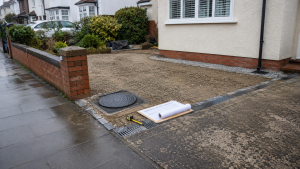
Bournemouth properties can present very different access conditions. The affected drain might be beneath a front drive, a paved side return, an established garden, a commercial yard or an internal floor. When planning a drain excavation in Bournemouth, the correct access plan depends on the actual site, not the postcode.
Before approving the excavation, establish:
- how workers and equipment will reach the area;
- whether spoil can be stored safely on site;
- whether paving can be lifted and reused;
- whether gates, fences or narrow passages restrict access;
- whether vehicles need to be moved;
- whether customers, tenants or neighbours use the route;
- whether an alternative access point would reduce damage;
- how the excavation will be protected outside working hours.
If the repair is under a driveway, also check the future loading on the reinstated surface and whether the drain cover or pipe needs additional protection. The article on Bournemouth driveway drainage checks covers access chambers and surface-water planning in more detail.
7. Have buried services been identified?
No one should begin digging simply because the drain position has been marked.
Electricity cables, gas pipes, water services and communications ducts may cross or run beside the excavation. Their recorded position may be incomplete, particularly where private services have been altered over time.
The Health and Safety Executive’s guidance on avoiding danger from underground services describes three basic elements of safe excavation: planning the work, locating and identifying buried services, and excavating safely.
The contractor’s method should therefore account for:
- available utility plans and property information;
- suitable locating equipment;
- markings on the ground;
- cautious digging methods around suspected services;
- safe support and access where excavation depth requires it;
- barriers preventing people from approaching an open excavation.
This is contractor-controlled work, not a homeowner’s DIY task. The customer does not need to design the safety system, but it is reasonable to ask how services have been checked and how the work area will be secured.
The HSE also states that danger to workers in or near excavations must be prevented and that no work should take place until the excavation is safe. That is relevant even when the opening looks small from the surface.
8. Could trees or established planting affect the plan?
Roots can complicate both the defect and the excavation. They may enter through an existing opening, occupy the surrounding ground or belong to a tree that must not be damaged casually.
If the repair is close to a mature tree, ask:
- whether roots are visible inside the pipe;
- whether root entry is the cause or a consequence of pipe failure;
- whether the excavation is likely to encounter major roots;
- whether the access point can be adjusted;
- whether an arboricultural opinion is needed;
- whether the tree is protected.
BCP Council’s Tree Preservation Order guidance states that permission is required before work is carried out to a tree covered by a TPO. The council also explains that trees in conservation areas can be protected even without an individual TPO. If the drainage work may involve cutting roots or other work to a tree, check the property’s actual status with the council before proceeding.
The aim is not to let roots dictate an unsuitable drain repair. It is to avoid creating a second problem by treating the surrounding garden as empty ground.
9. Are buildings, extensions or public sewers involved?
Drain layouts are sometimes changed, covered or made difficult to reach when extensions, garages and conservatories are built. A defect beneath or close to a structure needs more planning than an accessible garden repair.
The current Approved Document H for drainage and waste disposal covers below-ground drainage, protection of pipes, manholes and inspection chambers. Where the proposed work changes the drainage layout, replaces connections or affects drainage close to a building, the contractor should identify any Building Regulations considerations rather than assume the repair is exempt.
If a public sewer is involved, Wessex Water may also need to be consulted. Its guidance on building near or over a public sewer explains when consent or compliance with stated criteria is relevant.
Ask whether the proposed work:
- changes the route or fall of the drain;
- replaces or adds a junction;
- affects an inspection chamber;
- passes beneath or close to foundations;
- connects into a public sewer;
- requires work outside the property boundary;
- reaches a pavement, road or other publicly controlled land.
Most small private garden repairs will not involve every item on that list. The point is to identify the exceptions before digging begins.
10. What should the quotation say about the excavation?
“Excavate and repair drain” is too vague for significant work.
A useful written quotation should define the known scope clearly enough for the customer to compare it with the final job. Look for details such as:
- the location of the proposed excavation;
- approximate dimensions or the length of pipe to expose;
- the diagnosed defect;
- pipe diameter and replacement material where known;
- removal of the failed section;
- new pipe, junctions or chamber components;
- bedding and surrounding material;
- connection to sound existing pipework;
- testing or CCTV verification after repair;
- removal of spoil and waste;
- temporary barriers and site protection;
- the standard of surface reinstatement;
- whether matching paving or finishes can be guaranteed;
- responsibility for landscaping;
- working hours and expected duration;
- VAT and payment stages;
- guarantee terms and exclusions.
If the surface contains discontinued slabs, resin-bound material, decorative concrete or specialist paving, an exact visual match may not be possible. That should be discussed honestly. “Reinstated” can mean structurally sound and serviceable; it does not automatically mean invisible.
What happens if the excavation reveals something different?
Underground work always carries some uncertainty. The pipe may be deeper than expected, surrounding ground may be unstable, a junction may be closer to the defect, or previous repairs may become visible only after opening the ground.
The quotation should explain how variations are handled. A customer should not be pushed into approving an open-ended increase while the site is already excavated. Equally, a contractor cannot reasonably price every hidden condition as though it is confirmed.
A fair process is to pause, show the customer what has been found, explain any change and agree the revised work before continuing, unless immediate action is needed to make the site safe.
11. How should the replacement pipe be installed and checked?
Excavation is not successful merely because the broken piece has been removed. The replacement must be connected, supported and tested correctly.
Ask the contractor to explain:
- how the pipe will be laid to maintain the required fall;
- what bedding and surround will be used;
- how connections to the old pipe will be made;
- whether damaged adjacent material will be cut back to sound pipe;
- how open ends will be protected during the work;
- how flow will be tested;
- whether a post-repair CCTV check is included;
- how the excavation will be backfilled and compacted;
- when the surface can safely be used again.
A post-repair camera check can confirm that the new section is aligned, the connections are open and no debris has been left in the run. It also creates a useful record of the completed underground work before the surface is closed.
For professional drain repairs in Bournemouth, the recommended method should be based on the condition of the pipe and the requirements of the site—not simply on the equipment that is easiest to deploy.
12. What should happen on the day of the work?
The exact sequence will vary, but a controlled local repair commonly follows this pattern:
- The work area and access route are confirmed.
- The defect location and buried-service checks are reviewed.
- Barriers are placed around the work area.
- The surface is lifted or cut with reinstatement in mind.
- Ground is removed carefully until the drain is exposed.
- The diagnosis is checked against the visible pipe condition.
- The failed section is removed back to suitable pipework.
- The replacement is installed, connected and supported.
- Flow and connections are tested.
- The excavation is backfilled and compacted appropriately.
- The surface is reinstated to the agreed standard.
- The completed repair is recorded and the site is left safe.
If the visible condition differs materially from the survey finding, the customer should receive an explanation before the scope changes. Excavation is a chance to confirm the underground reality, not a reason to abandon clear communication.
13. Warning signs that the recommendation needs more work
Pause before approving the job if:
- no one can show you the defect;
- the pipe was too obscured for a meaningful survey;
- the location or depth is unknown;
- excavation is proposed only because a blockage returned;
- ownership has not been checked;
- the quotation does not identify what will be replaced;
- reinstatement is described only as “making good”;
- there is no process for approving additional work;
- buried services are treated as an afterthought;
- the contractor cannot explain why an internal repair is unsuitable;
- a large area is to be opened without a clear reason;
- the guarantee does not identify the repaired section or exclusions.
None of these automatically proves that the repair is unnecessary. They show that the decision is not yet documented well enough.
14. A practical pre-excavation checklist
Use this checklist before giving approval:
Diagnosis
- I have seen the relevant CCTV footage or clear stills.
- The engineer has explained the defect in plain language.
- The pipe was clear enough for the finding to be reliable.
- I understand why excavation has been recommended.
Location and ownership
- The damaged section has been located above ground.
- I know the approximate depth and repair length.
- Private, shared or public ownership has been checked.
- Any neighbour, freeholder, managing agent or water-company involvement is understood.
Access and safety
- The access route and work area have been agreed.
- Buried services will be located before digging.
- The excavation will be protected with suitable barriers.
- Trees, roots, buildings and boundaries have been considered.
Scope and reinstatement
- The quotation identifies the pipe work included.
- Testing or post-repair CCTV verification is stated.
- Waste removal and site clearance are included.
- The reinstatement finish is described.
- The process for unforeseen work is clear.
- VAT, payment terms and guarantee details are written down.
When should excavation be treated as urgent?
Not every structural fault needs the ground opened immediately. Urgency depends on what is happening at the property and what could worsen if the repair is delayed.
Prompt action may be needed where:
- sewage is escaping or backing up;
- essential toilets or facilities cannot be used;
- the pipe has completely lost flow;
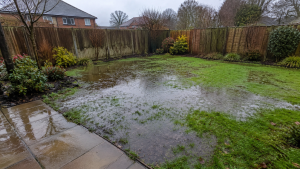
- ground is washing away around a failed drain;
- the surface is sinking or becoming unsafe;
- the fault threatens a building, retaining wall or other service;
- a commercial property cannot operate safely;
- temporary clearance cannot provide a reliable short-term solution.
Even in urgent conditions, the repair should remain controlled. The inspection, ownership and buried-service checks may need to happen quickly, but they should not be ignored.
Get the repair decision clear before the ground is opened
A drain excavation can be a precise, local repair. It does not have to mean digging up an entire garden or driveway. Before approving drain excavation in Bournemouth, establish the defect, location, ownership, access and reinstatement so the work can remain controlled.
If you have been advised that a drain needs excavating, Bournemouth Drains24 can inspect the pipework, explain the evidence and set out the available repair route. Where excavation is necessary, the proposed work should be proportionate to the confirmed fault and clear about what happens above and below ground.
Call 01202 406770 for the Bournemouth office or 07511 181 177 for urgent drainage assistance.
FAQs
Does a drain always need a CCTV survey before excavation?
Usually, a CCTV survey is the most practical way to confirm an underground defect and locate it before digging. There are exceptions, such as exposed damage or a failure that prevents the camera passing, but the contractor should still explain what evidence supports the excavation and how the target position was established.
Can a collapsed drain be repaired without excavation?
It depends on what “collapsed” means in that case. Some cracked or displaced pipes retain enough stable bore for an internal patch or liner. A fully crushed section, severe deformation, failed connection or pipe with an incorrect fall may need to be exposed and replaced.
Who is responsible for an excavated drain repair in Bournemouth?
The owner will commonly be responsible for a private drain serving only their property. Wessex Water is generally responsible for the public sewer network and most shared sewer pipes. The actual layout and position of the defect should be checked before private work is authorised.
Does drain excavation require planning permission?
A straightforward private drain repair will not normally need planning permission solely because the ground is being opened. Other controls may still apply if the work affects a public sewer, highway, protected tree, listed property, building structure or drainage layout. Check the specific site rather than relying on a general assumption.
Will the whole driveway or garden need to be dug up?
Not usually when the fault has been located accurately. Camera measurements and surface locating equipment can help target a relatively small area. A wider excavation may be required if the damage extends further than expected, the ground is unstable or safe working space is needed.
What should a drain-excavation quotation include?
It should identify the defect, location, approximate work area, pipe repair, testing, waste removal, reinstatement, price, VAT, exclusions, variation process and guarantee. It should also make clear what happens if the exposed pipe differs from the survey finding.
Should the repaired drain be surveyed again before backfilling?
A post-repair inspection is useful because it can confirm alignment, open connections and a clear bore before the excavation is closed. Ask whether CCTV verification or another documented flow test is included in the quotation.